2025
He Y.#*, Liu K.#, Mao L.#, Zhou F.#, Song J.#, Qi X.#, Wu D., … Mao Y.* & Su B.*
bioRxiv 2025 (Under review)
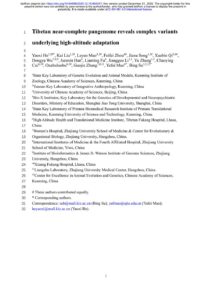
We construct a near-complete Tibetan pangenome based on 37 trios, uncovering previously missing structural variants and archaic introgressions driving high-altitude adaptation.
2025
He Y.#, Zhang X.#, Peng M.-S.#, Li Y.-C.#, … Kong Q.-P.*, Zhang Y.-P.* & Su B.*
Nature
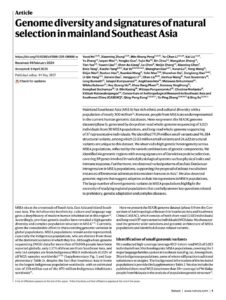
We present the SEA3K dataset of 3,023 Southeast Asian genomes, revealing extensive diversity and natural selection signatures for tropical adaptation.
2025
Zhang W.#, Chen X.#, Sun Y.#, Wang Y.#, Tang B., Liu K., Zhao W.*, Su B.* & He Y.*
Genomics, Proteomics & Bioinformatics
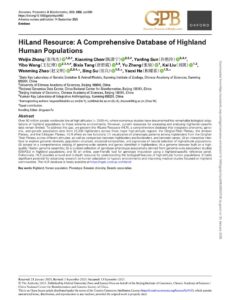
We present the HiLand Resource, a comprehensive open database of highlander phenomic, genomic, and genetic association data across global highlanders.
2025
Guo Y.#, Zheng W.#, Yue T.#, Baimakangzhuo, Qi X., Liu K., Li L., He Y.* & Su B.*
Journal of Genetics and Genomics
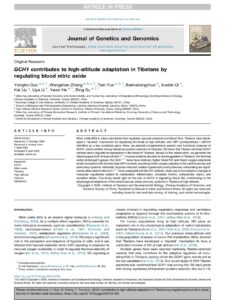
We demonstrate GCH1 selection in Tibetans reduces its expression, and knockout mice show higher blood NO and oxygen saturation under hypoxia.
2025
Qiao X.#, Shi J.#, Xu H.#, Liu K.#, Pu Y.#, … Su B., Tang W., He Y.*, Guo J.* & Yang Z.*
Communications Biology
We sequence 492 Central Plains Han Chinese genomes, uncovering dietary adaptation signatures in glycolipid metabolism genes from agricultural expansion.
2024
Yue T.#, Guo Y.#, Qi X.#, Zheng W.#, Zhang H.#, Wang B., …… He Y.* & Su B.*
eLife
We report male-biased placental transcriptomic divergence in Tibetans, with greater adaptive changes in male-infant placentas improving fetal development at altitude.
2023
He Y.#*, Guo Y., Zheng W., Yue T., … Wang Y., Zhang C., Xu S., Qi X. & Su B.*
Current Biology
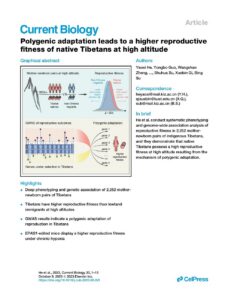
We demonstrate higher Tibetan reproductive fitness via polygenic adaptation involving both maternal and fetal genomes, supported by EPAS1 mouse models.
2023
He Y.#*, Zheng W.#, Guo Y.#, Yue T.#, Cui C.#, Ouzhuluobu, … Qi X.* & Su B.*
iScience
We deeply phenotype 11,880 highlanders, constructing an atlas of Tibetan adaptation and Han acclimatization, and identifying 45 novel high-altitude adaptive traits.
2023
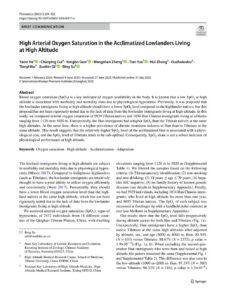
He Y., Cui C., Guo Y., Zheng W., Yue T., Zhang H., Ouzhuluobu, … Qi X. & Su B.*
Phenomics
We found acclimatized Han Chinese have higher arterial oxygen saturation than Tibetans at the same altitude with greater chronic mountain sickness.
2023
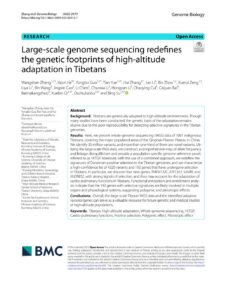
Zheng W.#, He Y.#, Guo Y.#, Yue T.#, Zhang H.#, … Qi X.*, Ouzhuluobu* & Su B.*
Genome Biology
We present whole-genome sequencing of 1,001 Tibetans and identify 192 positive selective genes underscoring polygenic high-altitude adaptation.
2022
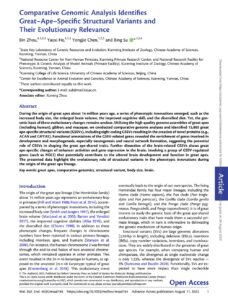
Zhou B.#, He Y.#, Chen Y. & Su B.*
Molecular Biology and Evolution
We identify multiple great-ape-specific structural variants by comprehensive comparative genomic analysis, highlighting their role in shaping great-ape traits.
2022
He Y.#, Li J.#, Yue T.#, Zheng W.#, Guo Y.#, Zhang H., … Ouzhuluobu*, Qi X.* & Su B.*
Phenomics
We find Tibetan birth weight peaks in winter with pronounced male-biased fluctuation, indicating male infants’ greater hypoxia sensitivity.
2022
Zhang X.#, Ji X.*, Li C.#, Yang T., … Ma S., Pang Y., Huang Y., He Y.* & Su B.*
Current Biology
We sequence a 14,000-year-old Southwest China genome, confirming its modern human identity and deep link to First American ancestry.
2020
Xin J.#, Zhang H.#, He Y.#, Duren Z.#, Bai C.#, … Wong W.H.*, Wang Y.* & Su B.*
Nature Communications
We generate hypoxia time-course multiomic data and develop vPECA, identifying causal SNPs and revealing the regulatory basis of Tibetan high-altitude adaptation.
2020
Ouzhuluobu#, He Y.#, Lou H.#, Cui C.#, Deng L.#, … Wu T., Xu S.*, Qi X.* & Su B.*
National Science Review
We de novo assemble a Tibetan genome, discovering novel structural variants including an MKL1 deletion associated with lower pulmonary pressure.
2019
He Y.#, Luo X.#, Zhou B.#, Hu T.#, Meng X.#, … Jin J., Guo Y., Yang Y., Qi X. & Su B.*
Nature Communications
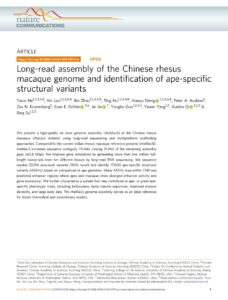
We assemble a high-quality Chinese rhesus macaque genome and identify 17,000 ape-specific structural variants linked to key evolutionary innovations.
2019
Luo X.#, He Y.#, Zhang C.#, He X.#, Yan L.#, Meng X., … Zheng P.*, Xu S.* & Su B.*
Nature Communications
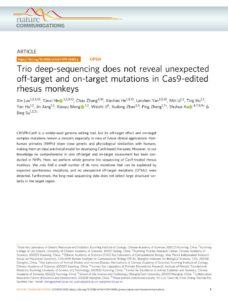
We use trio sequencing to show CRISPR-Cas9 editing in rhesus monkeys introduces no unexpected off-target or large on-target mutations.
2019
Qi X.#, Zhang Q.#, He Y.#, Yang L.#, Zhang X., … Han J., Zhao S., Liang C. & Su B.*
Genome Biology and Evolution
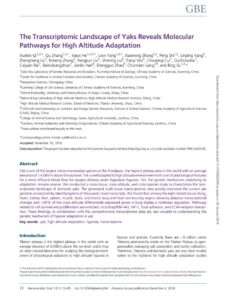
We refine the yak transcriptome across tissues and altitudes, revealing that lung and heart exhibit nonlinear adaptive expression changes under hypoxia.
2018
He Y.#, Qi X.#, Ouzhuluobu#, Liu S.#, Li J.#, … Zhang Y., Wu T., Su B.* & Cui C.*
National Science Review
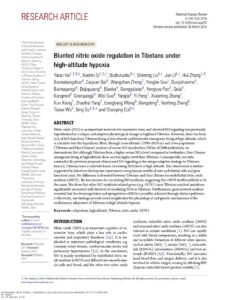
We refute uniquely elevated NO signaling in Tibetans, showing instead a blunted adaptive regulation compared to Han migrants at high altitude.
2017
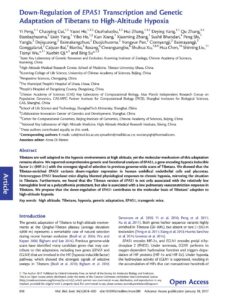
Peng Y.#, Cui C.#, He Y.#, Ouzhuluobu, … Chen H., Liu S., Wu T.*, Qi X.* & Su B.*
Molecular Biology and Evolution
We show Tibetan-enriched EPAS1 variants down-regulate its expression, providing a molecular basis for blunted hypoxic responses and polycythemia protection.
2017
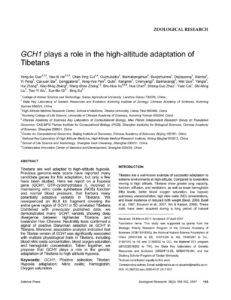
Guo Y.#, He Y.#, Cui C.#, Ouzhuluobu, Chen H., … Wu T., Qi X.* & Su B.*
Zoological Research
We detect positive selection on GCH1 in Tibetans and associate its variants with lower blood NO, oxygen saturation, and hemoglobin levels.
2017
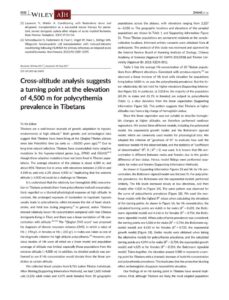
Zhang H.#, He Y.#, Cui C.#, Ouzhuluobu, … Zheng W., Guo Y., Wu T., Qi X.* & Su B.*
American Journal of Hematology
We identify a ~4,500 m turning point where Tibetan hemoglobin and polycythemia prevalence sharply increase, indicating blunted response altitude limits.
2017
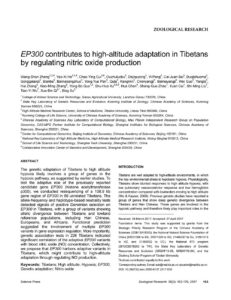
Zheng W.#, He Y.#, Cui C.#, Ouzhuluobu, … Cai Y., Liu S., Wu T., Qi X.* & Su B.*
Zoological Research
We find positive selection on EP300 in Tibetans and associate its variants with decreased blood nitric oxide, suggesting a role in high-altitude adaptation.